Amgen breaks ground on $365 million New Albany plant
The California-based biotech firm Amgen plans to break ground Friday on a $365-million packaging plant in New Albany.
For the firm’s CEO, Bob Bradway, the move represents a homecoming. Although he is now based in Southern California, Bradway grew up in Upper Arlington and graduated from Columbus Academy in 1981…Continue Reading at The Columbus Dispatch
New Albany International Business Park Adding Another Spec Building
New Albany’s International Business Park is gaining another speculative industrial building on the northwest corner of Innovation Campus Way and Harrison Road. A joint venture of Tenby Partners and Oakridge Development broke ground on a 130,000-square-foot project at 9360 Innovation Campus Way, Oakridge founder Tyler Ford told Columbus Business First. No tenants have been signed yet. Construction is expected to be completed by December…Continue Reading at Columbus Business First
Community Update from Jack W. Kessler | Summer 2021
This is my first New Albany community update in a long while, and I wanted to begin by saying I sincerely hope you and your family are healthy and doing well.
It’s been truly inspiring to watch our community come together, and to see so many individuals, organizations and businesses reach out to connect with and help others during the unprecedented challenges of the COVID-19 pandemic. The efforts of individuals, businesses and student organizations to produce and distribute personal protective equipment (PPE), and the scaling up of the New Albany Food Pantry to help families in need was a reminder of why this is such a special place to live and work. Read the complete update…
Amgen Builds Ohio Facility
Biotech firm to invest $365 million, create 400 jobs
Amgen one of the world’s leading biotechnology companies, is expanding its U.S.-based manufacturing footprint with plans to build a new, final product advanced assembly plant in New Albany near Columbus. The new greenfield facility will assemble and package vials and syringes to support the growing demand for Amgen’s medicines. The company plans to invest $365 million and create 400 new jobs upon opening. The site is expected to be operational by 2024…Read more at Ohio Business
Biotech Leader Amgen Expands to New Albany, Ohio
Columbus, Ohio – Amgen (NASDAQ:AMGN), one of the world’s leading biotechnology companies, announced today its plans to invest $365 million to build a new manufacturing facility in New Albany, Ohio, creating 400 new jobs upon opening. The facility will feature Amgen’s most advanced assembly and final product packaging capabilities for medicines to be distributed in the U.S. … Read more at Industry Today
Biotech firm to build $365 million packaging plant in New Albany
The biotechnology company Amgen plans to build a $365 million pharmaceutical factory in New Albany that will employ 400 workers.
The Ohio Tax Credit Authority Monday approved a state tax credit for the project in the New Albany International Business Park, near routes 62 and 161.
Amgen, based in Thousand Oaks, California, plans to start work in the fall on the 270,000-square-foot facility.
In a news release announcing the decision, the company said “the facility will feature Amgen’s most advanced assembly and final product packaging capabilities for medicines to be distributed in the U.S.”…Read the article at Dispatch.com.
Amgen to build $365M pharmaceutical plant in New Albany, creating 400 jobs
Biotechnology giant Amgen Inc. plans to build a $365 million pharmaceutical manufacturing and packaging facility in New Albany, creating 400 jobs over the next six years.
Construction is expected to begin this fall on the 270,000-square-foot facility in the city’s International Business Park in Licking County…Read the article at bizjournals.com.
New Albany Business Park Lures Projects with Move-In Ready Status
New Albany, mid-1990s. The affluent suburb was nine years into development under a master plan that was the vision of Les Wexner and partner Jack Kessler. For years, retail magnate Wexner had purchased land with a dream of building a community in the spirit of the iconic towns you’d see in rural England.
At the time, a stately country club, just four years old, was the focal point. Surrounding it were Georgian-style homes and the community’s signature white fencing…Read the full article at ColumbusCEO.com
New Albany Company’s Ebbing Named to Midwest Commercial Real Estate Hall of Fame
Each year, Midwest Real Estate News inducts a new class in its Midwest Commercial Real Estate Hall of Fame. This year, we are running these profiles online. We look today at the busy career of William (Bill) Ebbing, president of The New Albany Company in New Albany, Ohio.
Bill Ebbing oversees the development of The New Albany Company’s extensive holdings as part of a 12,000-acre master-planned community — the largest master-planned business park in the Midwest — including a 4,500-acre business park, upscale residential neighborhoods, a country club and a village center mixed-use district….Read the full article at rejournals.com
A Tribute to Jaquelin T. Robertson, Architect and Planner Who Helped Shape New Albany
“Places of value stand out among all places in the world. They’re recognizable. They leave a mark and an imprint in the memory. And that difference makes all the difference.”
— Jaquelin T. Robertson
 New Albany’s distinctive architectural identity is the result of a shared vision. One of the authors of that vision is Jaquelin T. Robertson (1933–2020), a world-renowned architect and planner who, during his half-century-long career, helped America rediscover its own architectural heritage.
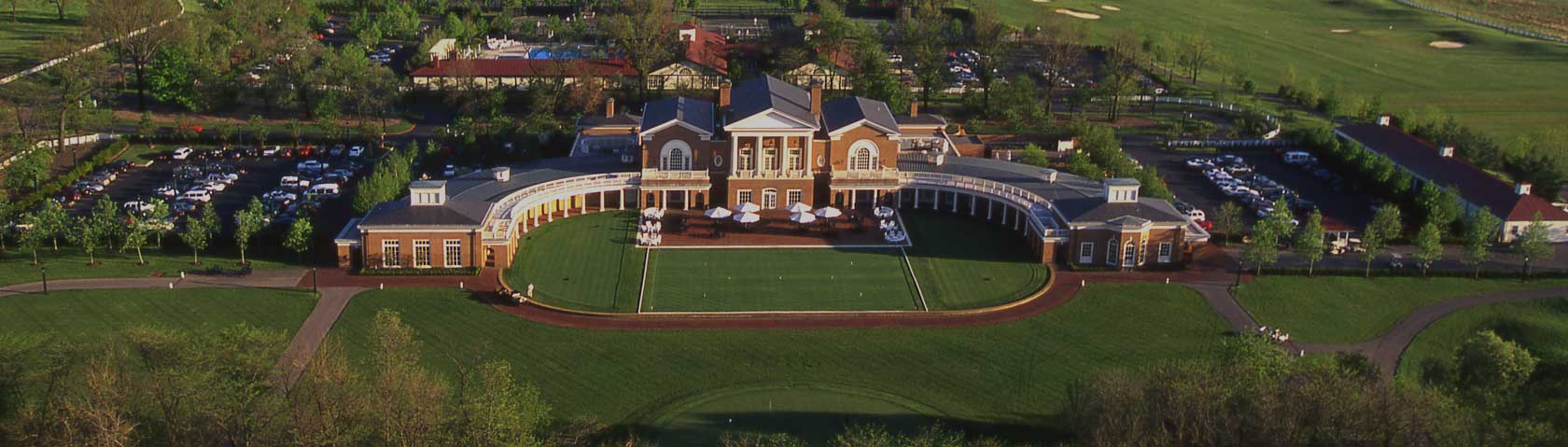
Mr. Robertson, known as “Jaque” (pronounced “Jack”), first began consulting for the New Albany Company in 1989. Having recently completed an eight-year tenure as dean of the University of Virginia School of Architecture, he and his New York City-based firm, Cooper Robertson, left an indelible mark on the community. Mr. Robertson led the design of the clubhouse at New Albany Country Club as well as Bottomley Crescent, one of the first streets to open in the Country Club Community. Mr. Robertson also helped craft the community’s master plan, working closely with Les Wexner and Jack Kessler, along with other expert planners such as Gerald McCue and Laurie Olin.
To ensure a consistently high quality of design throughout the community, Mr. Robertson helped train local builders and architects in the art of traditional brick construction. He also wrote some of the design guidelines for the Country Club Community, emphasizing harmonious composition and authentic details in the Georgian style. Mr. Robertson’s knowledge and guidance subsequently informed other architects’ designs for the community learning campus, the New Albany Branch Library, and Village Hall. As the community’s business park began to develop in the late 1990s, Mr. Robertson helped the New Albany Company create appropriate architecture and planning standards so that the commercial buildings would respect the landscape and the scale of the community.
Jaque Robertson grew up in Windsor Farms, Virginia, a graceful residential community on the edge of Richmond. Recalling a typical English village surrounding a common green, it served as one of several key precedents for the planning of New Albany. Mr. Robertson’s love of architecture was fueled by his family’s Georgian-Palladian home, called Milburne, which was designed by master architect William Lawrence Bottomley—the namesake of New Albany’s Bottomley Crescent. Mr. Robertson also spent part of his childhood in Beijing, where is father, the diplomat Walter Robertson, was stationed. This cosmopolitan environment helped fuel Mr. Robertson’s lifelong interest in urban design as a complement of architecture. Each individual building, he believed, should feel connected to the larger community. The parts should form a whole.
Mr. Robertson earned two degrees from Yale and studied at Oxford University as a Rhodes Scholar. In the early 1960s he worked for prestigious New York architect Edward Larrabee Barnes. He then became a senior urban planner in the administration of New York City Mayor John Lindsay, and took on international planning and design projects in the private sector. Returning to his native Virginia in 1980, Mr. Robertson led the architecture school at UVA, where he looked with fresh eyes upon the Classical tradition in architecture. He believed that Renaissance Italy and Georgian Britain and America still offered relevant lessons. His thinking was encapsulated in his treatise, In Search of an American Urban Order, in which he sought to apply Thomas Jefferson’s architectural principles to the challenges of modern life.
When Mr. Robertson came to New Albany, he was impressed with Wexner and Kessler’s vision to build a timeless American community. “To come upon this crowd in New Albany was just such a shock,” he recalled in 2015, during a Jefferson Series panel event at The McCoy. “Les was so committed to quality, and you don’t get that in our world anymore. No one in the country was doing things this way. It was so rare and so incredibly brave.”
Mr. Robertson showed Wexner and Kessler around some of his favorite buildings and communities, from Monticello to East Hampton, New York. When Wexner chartered a flight for roughly 45 Central Ohio builders and architects to go to Richmond for the day, Mr. Robertson led them on a tour of the city’s handsome Georgian homes. They returned with a clearer understanding of the subtle language of brick: specialized bonds or patterns, “grapevine” mortar joints, water tables, arched openings, glazed headers, decorative “rubbed” bricks, and many other techniques.
As Mr. Robertson once said in a Town & Country interview, “The symbolic hard currency of architecture is classical. It’s gold in the bank. The other stuff is leveraged buyouts and soybean futures.”
Apart from his work in New Albany, Mr. Robertson is remembered for his role in designing civic and university buildings, museums, corporate headquarters, club/resort environments, and community master plans. He also designed elegant country homes for prominent clients, typically evoking the spirit of older buildings without imitating them directly. He received the Thomas Jefferson Medal in Architecture in 1998 and the Driehaus Prize, an award for excellence in traditional architecture, in 2007.
New Albany honors the memory of Mr. Robertson, and we treasure his enduring contributions to our community.